Side-by-side
Vendor statements only; we have not run speed tests. [1][2][3][4]
| Factor | WireGuard | OpenVPN |
|---|---|---|
| Speed on router hardware | Usually faster, per GL.iNet; especially on lower-end hardware, per Proton | Slower, per the same vendor statements |
| Transport | Usually a specific UDP port | UDP or TCP; Proton TCP configs use port 443 |
| Blocked networks | Easy to block when on UDP | TCP helps against blocks; still detectable by deep packet inspection |
| Code size, per Proton | Under 4,000 lines | Over 300,000 lines |
| Proton VPN on routers | Supported (manual .conf) | Supported (manual .ovpn) |
| NordVPN on GL.iNet | Built in via access token | Built in via service credentials, or manual .ovpn |
Why WireGuard is the default on a travel router
Proton says WireGuard is faster than OpenVPN and IKEv2 especially on lower-end hardware, and GL.iNet's OpenVPN Client documentation says it recommends WireGuard as it is usually faster than OpenVPN. [1][2]
Setup is also simpler on GL.iNet: firmware v4.7 and later builds NordVPN WireGuard in with an access token, and any provider that issues a .conf file, including Proton, can be uploaded under WireGuard Client. [6]
When OpenVPN TCP is worth the speed loss
Proton states that WireGuard usually runs over a specific UDP port, which makes it easy to block, and that OpenVPN keeps strong anti-censorship capabilities because it can run over TCP. Proton's manual OpenVPN downloads offer UDP (recommended) or TCP, which Proton suggests if you experience slow VPN speeds; the TCP option uses port 443, the same port as ordinary HTTPS. [1][3]
NordVPN's GL.iNet article uses OpenVPN files and lets you download a UDP or a TCP version for each server, so you can keep a TCP profile loaded as a spare. [5]
Proton also cautions that deep packet inspection can still tell VPN packets from HTTPS, so TCP 443 improves the odds on a filtered network without guaranteeing a connection. [1]
What each provider supports on a router
Proton's product lifecycle page lists both WireGuard and OpenVPN as supported for routers and Stealth as not available there. Its app-only anti-blocking features therefore do not help a router tunnel. [4]
NordVPN on GL.iNet has both a built-in WireGuard path and OpenVPN paths. GL.iNet says the NordVPN service credentials for OpenVPN are not your login email and password. [6][2][5]
Decision rule by network type
Load both profiles before you travel so switching is a click, not a download on a network that is already failing.
| Network | Start with | Fallback |
|---|---|---|
| Home, office or friendly hotel Wi-Fi | WireGuard (UDP) | Another WireGuard server |
| Hotel or airport Wi-Fi where WireGuard times out after login | OpenVPN TCP (port 443 on Proton) | The provider app on a laptop with Stealth or obfuscation |
| Network that blocks every protocol | Mobile data or tethering | Wait for another network |
| Slow upstream link, such as a phone hotspot | WireGuard | No tunnel for non-sensitive traffic if it is too slow |
Setup checklist
- Load one WireGuard profile and one OpenVPN TCP profile per provider. [5][6]
- For Proton OpenVPN, choose the download platform carefully; Proton warns that picking the wrong one may leave you vulnerable to DNS leaks. [3]
- For NordVPN OpenVPN, keep the service credentials in a password manager. [5]
- Label profiles with protocol, server and date.
- After each switch, check your public IP and DNS on a leak-test page.
Watch demos / Official walkthroughs
See the hardware in action.
Videos load from YouTube only when you press play. These are provider videos, not our own product tests.

GL.iNet / Official video
Beryl AX (GL-MT3000) - Unboxing and Setup Guide
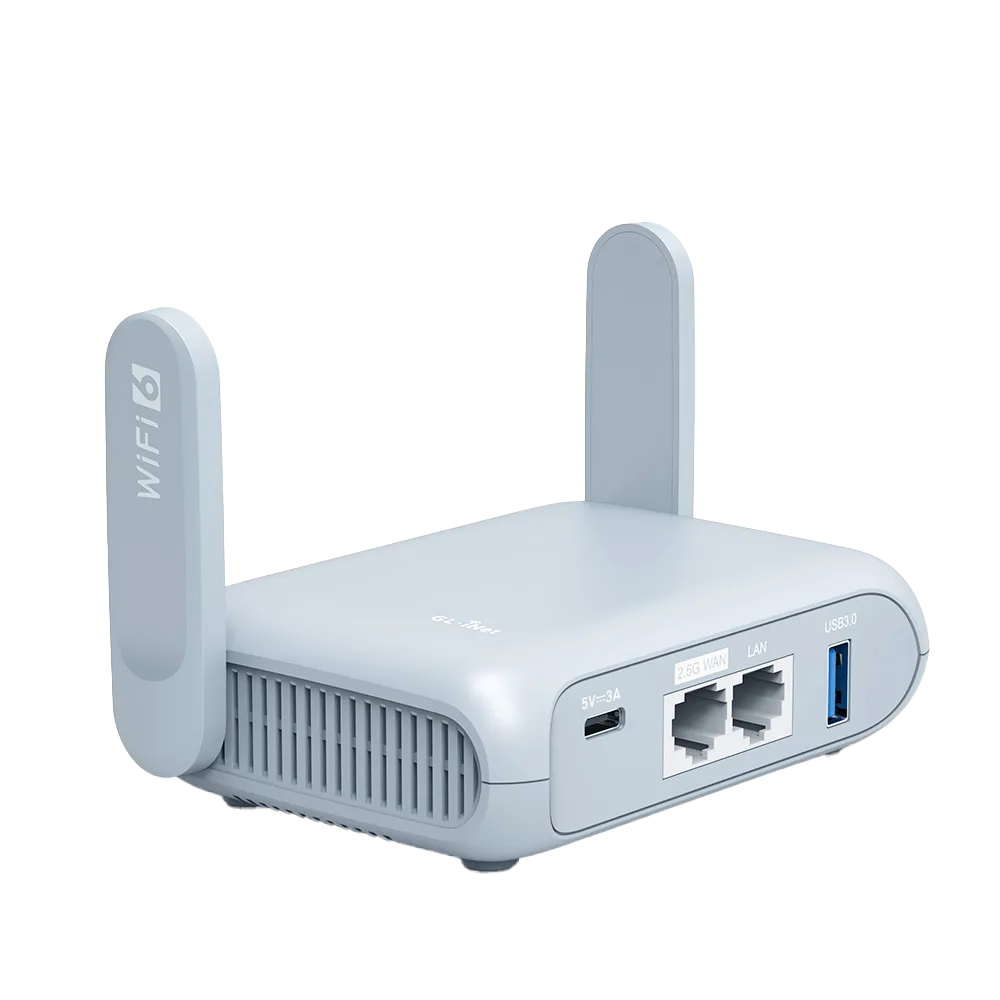
What to look for: Identify the hardware connections and setup steps for Beryl AX; other models can differ.
Watch on YouTubeQuestions before you decide
Is WireGuard faster than OpenVPN on a travel router?
GL.iNet says WireGuard is usually faster than OpenVPN, and Proton says WireGuard is faster than OpenVPN especially on lower-end hardware. Check the router product page for the vendor maximum throughput per protocol.
When should I use OpenVPN TCP instead?
When a network blocks UDP VPN traffic. Proton notes that WireGuard usually uses a specific UDP port that is easy to block and that OpenVPN can run over TCP; its manual OpenVPN TCP configs use port 443.
Sources & verification
Product details and prices can change. Check the linked provider before buying.
- Proton VPN blog: What is WireGuard? Accessed 30 Oct 2026
- GL.iNet Router Docs 4: OpenVPN Client Accessed 30 Oct 2026
- Proton VPN: How to download OpenVPN configuration files Accessed 30 Oct 2026
- Proton VPN: Product lifecycle stages (feature availability by platform) Accessed 30 Oct 2026
- NordVPN Help Center: GL.iNet setup with NordVPN Accessed 30 Oct 2026
- GL.iNet Router Docs 4: WireGuard Client Accessed 30 Oct 2026
Sources link directly to providers. Product buttons may use separately labeled affiliate links. Read our disclosure.