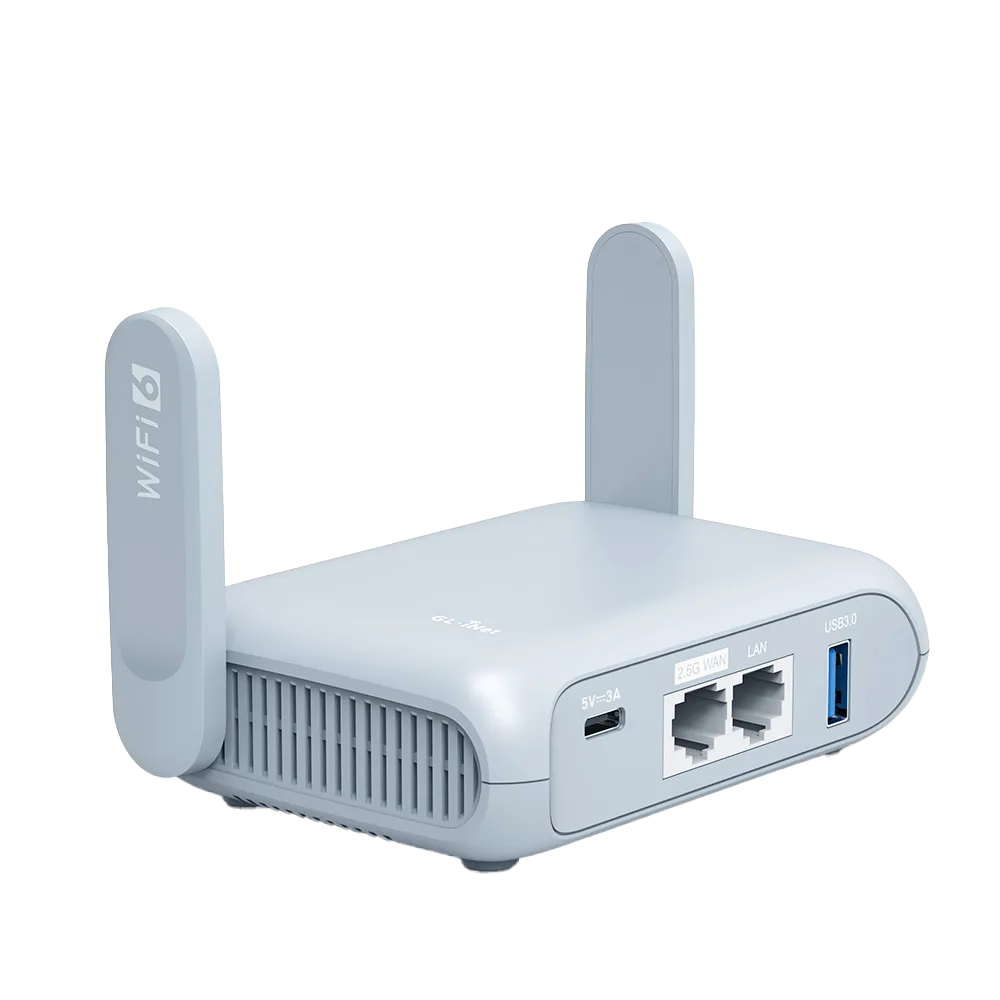
A spec-by-spec comparison of GL.iNet's $39.99 Opal and $98.99 Beryl AX travel routers: ports, Wi-Fi, VPN speed limits, power and weight, with who should buy which and who should buy neither.
Choose the route by what you need to reach: one Tailscale device, a private network device, or the public internet. Then verify permissions and the actual destination.
Research guide with an original synthetic exercise · Updated
Map every cable, port and power source for an Opal or Beryl AX travel kit before you pack, with a port-by-port table and a home test that catches missing adapters.
A step-by-step fix for the hotel sign-in page that never appears behind a GL.iNet travel router: what to check first, the three documented fixes, and how to turn your protections back on.
Find which link fails before spending: free checks first, cheap fixes next, and a new router such as the $169.99 Flint 2 only when the evidence points there. Built around a $50-a-month discretionary budget.
A VPN protects the path from your device; a travel router gives you your own small network behind one hotel login. Which one you need, when you need both, and what each costs.
What a home router like GL.iNet Flint 2 adds over an ISP gateway, what you give up, and the setup checks that decide between router mode, access-point mode, or keeping what you have.
How to tell whether you have double NAT or carrier-grade NAT, when it actually breaks something, and the fixes in order: remove, bridge, or access-point mode.
Router-level VPN covers every client on your travel LAN but is capped by the router; a device app moves with the device. Compare listed throughput, kill-switch scope and setup work.
Which GL.iNet models support Tailscale, what Advertise LAN Subnets, Custom Exit Nodes and Run Exit Node do, and the conflicts and approvals that trip people up.
When your phone is the only internet connection, a GL.iNet travel router can take it over a USB cable or as a Wi-Fi repeater. Check the carrier plan, power, and heat before adding the router at all.
Zoom, Microsoft Teams and Google Meet publish bandwidth figures for HD video and screen sharing. Use them to size a household connection, and remember that upload is usually the tighter direction.
Latency under load can break calls on a fast line. Here is how to measure it, what SQM and QoS do on OpenWrt and GL.iNet firmware 4, and the throughput and CPU costs.
Compare the ways to bring a wired connection to a desk: a new Ethernet run, MoCA over existing coax, powerline or G.hn adapters, and wired backhaul for mesh points. Covers what the standards bodies claim and the common installation traps.
Keep the internet running through short power cuts. This guide covers reading device power draw, VA versus watts, using a UPS maker's runtime tool, and what no home UPS can cover.
A research review of GL.iNet's Beryl AX built from its datasheet and firmware documentation: the 2.5G WAN port, listed VPN ceilings, USB tethering, hotel login handling, power draw and size, with who should buy it and who should skip it.
Research review (vendor datasheet and documentation; no firsthand testing) · Updated
A research review of GL.iNet's $39.99 Opal from its product page and documentation: Wi-Fi 5, three gigabit ports, a 65 Mbps WireGuard ceiling and a 12 Mbps OpenVPN ceiling, with a worked example of when the VPN limit bites and when to step up.
Research review (vendor product page and documentation; no firsthand testing) · Updated
Official specs for Beryl AX next to GL.iNet Opal, TP-Link TL-WR1502X, TP-Link TL-WR902AC and ASUS RT-AX57 Go: Wi-Fi standard, WAN speed, VPN support, tethering and power, with decision rules by trip type.
Research comparison (vendor specification pages; no firsthand testing) · Updated
A brand-level comparison from vendor spec and support pages: GL.iNet's OpenWrt-based firmware and plug-ins against TP-Link's Tether-app firmware, VPN client and server options, hotel login handling, update history and power needs.
Research comparison (vendor specification and support pages; no firsthand testing) · Updated
A decision checklist for rentals: weak signal in one room, a shared host network, streaming-stick logins and work calls. What a travel router can fix, what it cannot (a slow upstream line), and how to read Airbnb's wifi speed labels before booking.
Research guide (platform help pages and vendor documentation; no firsthand testing) · Updated
What Carnival, Royal Caribbean and Norwegian publish about Wi-Fi device limits and prohibited equipment, why a travel router is banned or at risk on these lines, and the cheaper legal ways to connect several devices.
Research guide (cruise line policy and package pages; no firsthand testing) · Updated
Why a Chromecast or Google TV Streamer fails on hotel Wi-Fi (captive portals and client isolation), how putting the stick and your phone on a travel router's private network works around both, a step checklist from Google and GL.iNet documentation, and what a router cannot fix.
Research guide (Google and GL.iNet documentation; no firsthand testing) · Updated
Why consoles stall on hotel login pages and restrictive NAT, what Nintendo and Sony document, when the console's own login flow is enough, and the router-side steps that help, including why UPnP on a travel router usually cannot open a hotel's NAT.
Research guide (Nintendo, Sony and GL.iNet documentation; no firsthand testing) · Updated
A pre-trip setup sequence for a GL.iNet travel router, done at home from GL.iNet documentation: admin password, firmware check, network name, a repeater test, a VPN profile and a settings backup, with a printable checklist.
What each GL.iNet network mode does, when to use it in a hotel, a rental with Ethernet or at home, and which features you lose: VPN, AdGuard Home, guest Wi-Fi and the login-page helper.
Compares a router with built-in cellular, a USB modem plugged into a travel router, and plain phone tethering on hardware, SIM handling, plan restrictions and setup, with a two-week trip worked through.
A troubleshooting ladder from GL.iNet documentation: which reset to try first, how long to hold the button, what each one erases, and when you need U-Boot web recovery instead.
What the AdGuard Home app built into GL.iNet firmware does, how its Handle Client Requests option interacts with VPN policies, DNS settings and hotel login pages, which models support it, and when a VPN app blocker is the better fit.
Step-by-step from GL.iNet documentation: check for a public IP, set up DDNS, run the WireGuard server on a Flint 2 at home, import the profile on a Beryl AX, and test everything before you leave.
How a tunnel to your own home router differs from a commercial VPN server in your home country, and which fits banking logins, work location checks or privacy on hotel Wi-Fi, with costs and requirements from vendor pages.
University residence hall policies range from an outright ban on personal wireless routers to allowing a registered wired-only router. Here is what five IT departments say, why, and a checklist for reading your own school policy before you buy.
Why a router VPN plus a company VPN can stall a work laptop, how to keep the laptop out of the router tunnel on GL.iNet firmware, which MTU numbers vendors publish, and what to ask IT before the trip.
When the room's wall jack is worth trying, how GL.iNet's Ethernet WAN settings work, what to do about a wired login page, and a short troubleshooting tree for jacks that give no internet.
Repeating park Wi-Fi with a travel router, adding a cellular router with a roof antenna, or pairing cellular with satellite: what GL.iNet documents for each, who each fits, and what to measure at the site.
What GL.iNet's Parental Control and AdGuard Home features do according to its docs, which travel models support them, and how they compare with Apple Screen Time and Google Family Link on the device.
NordVPN and Proton VPN compared from their own pricing, support and terms pages: billing and renewal, simultaneous devices, router configuration files, refund rules, free options and obfuscation.
A research review of NordVPN from its own support documentation: billing and renewal, the 10-device limit and router slot, manual router configuration, obfuscated servers, refund terms, and who should skip it.
The three documented ways to run NordVPN on a GL.iNet router (built-in WireGuard with an access token, built-in OpenVPN with service credentials, and manual .ovpn upload), plus device slots, kill switch settings and a troubleshooting checklist.
How to generate a Proton VPN WireGuard configuration file, which options each plan unlocks, how to load it into a GL.iNet router, what port forwarding needs, and how to manage several configs.
What NordVPN and Proton VPN say about simultaneous connections, why a router counts once, the per-server catch, and a worked family-trip example with and without a travel router.
What the Proton VPN and NordVPN app kill switches block, how a GL.iNet router kill switch differs, why both stop hotel login pages, and a short IP and DNS leak check.
An ordered troubleshooting path from the vendors own support pages: finish the captive portal, switch protocol, try TCP on port 443 or obfuscation, check the clock and firewall, and know when the network blocks VPNs outright.
Why WireGuard is the default on a GL.iNet travel router, when OpenVPN over TCP is worth the speed loss, how Proton VPN and NordVPN support each on routers, and a decision rule by network type.
A research review of GL.iNet Comet Pro from its product page and official docs: virtual media, cloud versus Tailscale versus local access, power-control add-ons, security settings, price, and who should skip it.
Comet Pro and JetKVM compared from official pages and docs: price, video and latency claims, network links, virtual media, cloud and Tailscale access, open-source status and power-control options.
Many servers and business PCs already include out-of-band management. Learn what Intel AMT, Dell iDRAC and Supermicro BMCs offer, how licences gate features, and a checklist to decide whether an external KVM adds anything.
A step-by-step plan for remote firmware access and OS reinstalls with a KVM-over-IP: getting the BIOS on screen, mounting an ISO, choosing the boot device, and estimating upload time before you start.
A remote KVM gives full control of a computer from boot. This checklist, based on CISA guidance and GL.iNet and JetKVM documentation, covers passwords, two-factor sign-in, avoiding port forwarding, access paths, updates and physical access.
How to reach several computers through one KVM-over-IP: multi-port devices, pairing with a KVM switch, the EDID, USB and hotkey problems vendors document, power control per machine, and how the cost compares with one KVM each.
Tailscale and ZeroTier compared from their pricing pages and docs: free-plan limits, device counts, commercial use, relay behavior when direct connections fail, and support on GL.iNet and OpenWrt routers.
How to tell whether your ISP puts you behind carrier-grade NAT, why port forwarding and dynamic DNS then fail, and which remote-access options still work: mesh VPNs, vendor relays, tunnels, IPv6 or a public IP from your ISP.
A research review of GL.iNet Flint 2 from its datasheet and firmware docs: 2.5G ports, Wi-Fi 6, rated VPN throughput, OpenWrt access and price, with who it fits and who should skip it.
GL.iNet Flint 2 (Wi-Fi 6) and Flint 3 (Wi-Fi 7) compared from their datasheets: radios, 2.5G ports, rated VPN speed and price, with a worked example of when Wi-Fi 7 changes nothing.
How Flint 2 compares with ASUS RT-AX86U Pro, TP-Link Archer BE550, GL.iNet Flint 3 and official OpenWrt for router-level VPN: WireGuard support, port speeds, policy routing and firmware openness.
How GL.iNet firmware 4.9 VPN policies route traffic by device, connection type, domain or IP. When an app's own split tunneling is simpler, a worked household example, and a checklist for proving it works.
Plain trade-offs from OpenWrt and GL.iNet documentation: package flexibility, VPN options, how updates work, who supports what, and how things break. Includes who should stay with an ISP or mainstream router.
Why to keep smart-home devices away from work laptops, how a guest network compares with a VLAN, what tends to break (casting and discovery), and what GL.iNet firmware documents for each.
What DoH and DoT protect according to the RFCs, what still leaks, how router-level and browser-level settings interact with a VPN and hotel captive portals, and how to check it works on GL.iNet firmware.
Backup internet options for remote workers: phone USB tethering, a second ISP or fixed wireless. Covers hotspot data limits in carrier terms, how GL.iNet Multi-WAN detects failure, a cost worked example and a failover test.
Sourced facts only: who makes GL.iNet routers, the OpenWrt base, what public vulnerability records show for 2026, how fixes ship through firmware, and a hardening checklist for the admin password, remote access and updates.
Only the promotions GL.iNet publishes on its own store, checked 30 October 2026: the Student Beans student discount, the Weekly Wednesday Deals newsletter and promotion return rules, with a worked price example for Beryl AX, Opal and Flint 2.
What GL.iNet's published policy says about the 30-day return window, the 24-month router and KVM warranty, what voids a claim, how the replacement process works, and why Amazon and other retailer purchases follow the seller's policy instead.
Spec-sheet comparison of GL.iNet Beryl AX (GL-MT3000) and ASUS RT-AX57 Go: ports, USB tethering, VPN client and server support, hotel login handling, power input and price, with who should pick each and who should skip both.
Entry-level GL.iNet decision from the official spec pages: dual-band Opal (GL-SFT1200) versus single-band Mango (GL-MT300N-V2), with port count, power input, published VPN figures, firmware documentation and two worked examples.
Documentation comparison of GL.iNet Comet Pro (GL-RM10) and Sipeed's NanoKVM family: video resolution, virtual media, ATX power control, network, remote access path (cloud or self-hosted), price and published security records.
GL.iNet's own troubleshooting order for an admin page that will not load: confirm you are on the router's network, try a cable, find the real gateway address, rule out a 192.168.8.x subnet clash, clear browser and VPN interference, and only then reset.
What to check when a GL.iNet travel router says the repeater is connected but the internet cannot be accessed: captive portal login mode, subnet conflicts, DNS and AdGuard Home settings, and VPN kill switch behaviour, from GL.iNet's own documentation.
A fix-it checklist for a GL.iNet Comet Pro (GL-RM10) that shows a black screen or 'No HDMI signal', built from GL.iNet's own KVM documentation: port order, transfer mode, resolution and EDID limits, the target PC's sleep and GPU state, firmware, and when to stop troubleshooting.
Research guide (GL.iNet documentation; no firsthand testing) · Updated
How to choose a travel router for months-long stays, from GL.iNet specifications and documentation: a home-router tunnel for a stable home IP, phone tethering as a fallback, power input, realistic VPN throughput, and when a phone hotspot is enough.
Research guide (vendor datasheets and documentation; no firsthand testing) · Updated
The specs that decide whether a router can run a VPN for a whole household (published WireGuard and OpenVPN throughput, CPU, policy routing, provider integration), mapped to line speed, with a worked 500 Mbps example that keeps two streaming TVs off the tunnel.
Research guide (vendor datasheets and documentation; no firsthand testing) · Updated
The verifiable record on NordVPN: who owns it, where it is based, what it says about logging, the March 2018 breach of a rented server in Finland as reported in 2019, and a checklist for configuring it safely while travelling. Audit reports are not summarised here; read them on NordVPN's audit pages.
Research guide (company documentation and press reporting; no firsthand testing) · Updated
Step-by-step from NordVPN's help centre: turning off auto-renewal, requesting a refund inside the 30-day window, how long the money takes, and why App Store, Google Play and Amazon purchases follow the store's rules instead.
Research guide (NordVPN, Apple and Google help pages; no firsthand testing) · Updated
NordVPN and Surfshark have shared a holding company since 2022. This compares what each documents on device limits, GL.iNet router setup, pricing and renewal terms, trials and refunds, and who should pick which.
Research comparison (vendor documentation and pricing pages; no firsthand testing) · Updated
NordVPN and ExpressVPN compared from their own pricing, router and support pages: how each works on a GL.iNet travel router, simultaneous devices, protocols for restrictive networks, first-term and renewal prices, refunds, and who should skip both.
NordVPN Meshnet and Tailscale compared from their own documentation: device limits, free terms, routing traffic through a home computer, reaching home network devices, platforms that can act as the exit, and travel-router support.
NordVPN's own troubleshooting order for a connected tunnel with no internet: server and protocol changes, DNS and Real-time protection, kill switch and captive portals, then GL.iNet router fixes kept separate from device-app fixes.
The verifiable record on Proton VPN: Swiss legal framework as Proton documents it, open-source apps, annual Securitum no-logs audits, transparency report figures, and how the 2021 Proton Mail IP case differs from the VPN.
Only the discounts Proton publishes on its own pricing page, checked on 30 October 2026: the two-year VPN Plus and Proton Unlimited prices, what renewal costs, a worked cost table, and why no coupon code is needed.
Proton's documented steps to cancel on the web, iPhone and Android, the 30-day refund rule and its exceptions, credits versus refunds, and a checklist for router WireGuard configurations after you drop to Free.
Proton VPN and Mullvad compared from their own pricing, help and audit pages: account model, flat versus term pricing, device limits, WireGuard setup on GL.iNet routers, free tier, payment and refund rules, and published audits.
A plain-language explanation of how a travel router works: where its internet comes from, how NAT and a private network let one hotel login cover every device, and what the box cannot fix. Specs from GL.iNet product pages.
A timed first-use sequence for a GL.iNet travel router in a hotel: power and connect, join the hotel Wi-Fi in Repeater, finish the portal, check your devices, then turn on a VPN last. Built from GL.iNet documentation.
Forty-one travel router terms defined in a sentence or two, each with what it means in a hotel or rental and the GL.iNet documentation page where its setting lives. Grouped by setup, connection source and security.
What Delta and Southwest publish about in-flight Wi-Fi logins and devices, why a pass bought for one device should not be shared through a router, what a travel router draws from seat power, and when a phone or laptop alone is simpler.
Which GL.iNet routers can join WPA-Enterprise (802.1X/EAP) networks such as eduroam, the model and firmware caveats in GL.iNet's own tutorial, the parameters to ask IT for, the credential-responsibility question, and wired and tethering fallbacks.
How regulatory domains set Wi-Fi channels and power by country, why a router under one country's rules may not see a hotel network on another country's channels, and what GL.iNet documents about region, channel and transmit power.
What the Beryl AX and Opal USB ports can do as network storage, per GL.iNet documentation: Samba, WebDAV and DLNA support, drive formats, the FAT32 4 GiB file limit, power, and the sharing settings to check before you plug a drive in.
Research guide (GL.iNet documentation and datasheets, Microsoft file system reference; no firsthand testing) · Updated
How to use a Beryl AX or Opal at home in Extender, Access Point or Router mode, what each mode turns off according to GL.iNet, the port and Wi-Fi limits from the datasheets, and when a full home router such as Flint 2 is the better tool.
Research guide (GL.iNet documentation and datasheets; no firsthand testing) · Updated
A dated checklist for remote workers: what to settle two weeks out, what to rehearse at home a week before, what to write down the night before and what to do on arrival, using GL.iNet, NordVPN and Proton VPN documentation.
Research guide (GL.iNet, NordVPN and Proton VPN documentation; no firsthand testing) · Updated
What Starlink's support pages say about bypass mode by hardware generation, why only a physical factory reset turns it off, the router-side WAN setup, how to check for CGNAT, and a note for Starlink Mini on the road.
Research guide (Starlink support articles, GL.iNet documentation and IETF RFC 6598; no firsthand testing) · Updated
What T-Mobile's support page says about third-party routers, bridge mode, gateway Wi-Fi, NAT and port forwarding, how to cable and set up your own router behind the gateway, and what a personal router can and cannot fix.
Research guide (T-Mobile support page, GL.iNet documentation and IETF RFC 6598; no firsthand testing) · Updated
How AT&T IP Passthrough works with the gateway still in place, the gateway-side settings from AT&T's support article, the router WAN settings, what to do about gateway Wi-Fi, and how to confirm your router received the public IP.
Research guide (AT&T support articles and GL.iNet documentation; no firsthand testing) · Updated
What Xfinity bridge mode switches off, how to turn it on and back off at 10.0.0.1, the own-modem alternative and its limits, and a router-side checklist for the switch.
How PPPoE logins and ISP VLAN IDs work, real examples from three ISPs, where GL.iNet puts the PPPoE, VLAN and MTU fields, why 1492 matters, and the questions to ask your ISP before you swap routers.
A step-by-step migration from an old or ISP router to a new one: what to record, how to match the Wi-Fi name, password and security mode, where GL.iNet keeps each setting, the cutover order and a rollback plan.
The watts x 8,760 hours x rate formula worked for a modem plus router, a three-unit mesh and a router-KVM-switch desk setup, using vendor power figures and EIA's August 2026 residential prices, with the low and high state range.
How Wi-Fi 7 MLO combines bands, the STR and EMLSR modes, why the laptop or phone must support it too, which Apple devices list MLO, and who gains from it now versus a Wi-Fi 6 router.
What DFS is under FCC and ETSI rules, the 60-second and 10-minute radar checks, why 5 GHz drops when radar is detected, a US and EU channel table, and where GL.iNet and Meraki let you include or exclude DFS channels.
Plain-language definitions of home router spec-sheet terms, each with a note on whether it matters for a home office, cross-referenced to where Flint 2 and Beryl AX spec sheets use them.
What the Stable, Beta and Snapshot tabs on GL.iNet's download center mean, how to decode a firmware file name, why the 4.x version number says nothing about the OpenWrt base, and who should stay on stable.
How the LuCI backup on GL.iNet routers works, what the archive includes and leaves out, the firmware-version rule that decides whether a restore will work, and a checklist for moving to a replacement unit.
A migration walkthrough for Flint 2 and Beryl AX: confirming support, picking the right OpenWrt 25.12 image, flashing from the GL.iNet panel, what changes afterwards, and the two documented routes back to GL.iNet firmware.
What GL.iNet publishes about support periods and discontinued models, what its release history shows for Opal, Beryl AX and Flint 2, how that compares with TP-Link, NETGEAR, ASUS and OpenWrt, and how to check a model's last firmware date yourself.
Twenty-nine VPN terms defined from Proton VPN, NordVPN, WireGuard and GL.iNet documentation, each marked as an app feature, a router feature or both, with notes for GL.iNet travel routers.
A line-by-line walk through a WireGuard .conf file using the official wg and wg-quick manuals, how a Proton VPN config differs from a home-server config made on a GL.iNet router, and the edits travelers actually make.
How VPN obfuscation works at a high level, what Proton's Stealth protocol and NordVPN's NordWhisper-based obfuscated servers are, where each one runs, why router setups usually cannot use them, and when a traveler actually needs one.
How Proton VPN's Secure Core routes traffic through its own servers in Switzerland, Iceland and Sweden, which plans include it, why Proton itself says it adds a lot of latency, how it works on routers, and when a traveler should turn it on.
A day-one leak check for a VPN running on a GL.iNet travel router: what DNS, IPv6, WebRTC and tunnel-down leaks are, which router settings control each one, the free test pages to use, and a pass/fail checklist with fixes.
Refund windows and exclusions for NordVPN, Proton VPN, ExpressVPN, Surfshark and Mullvad in one table, taken from each provider's terms or help pages: renewals, app-store purchases, cash and crypto, add-ons and processing times.
How to move a GL.iNet router from an OpenVPN profile to WireGuard without losing a working fallback: get the WireGuard config from NordVPN or Proton VPN, run both side by side, test, then trim OpenVPN down to one TCP profile for networks that block UDP.
What is inside a KVM-over-IP box and why it reaches the BIOS when remote-desktop apps cannot: HDMI capture and EDID, USB keyboard and mouse emulation, virtual drives, and front-panel power control, with GL.iNet Comet Pro and PiKVM documentation as worked examples.
What sets a remote KVM's bandwidth, the vendor settings that cut it (quality presets, smart mode, FEC, codecs, frame rate), how to measure your own stream on a phone hotspot, and a calculated data-use table for planning a session.
What a remote KVM needs from a laptop or Mac: an HDMI or USB-C video output, the primary-display problem that hides the BIOS on laptops, Mac keyboard and startup-key behavior, staying awake, and why power control is harder without desktop ATX headers. Includes a per-device compatibility table.
What GL.iNet's GoodCloud lets you do remotely, how binding differs by firmware, what GL.iNet says it stores, the security trade-offs, and how to disable or unbind it.
Inventory every open port, put Tailscale on the router or the hosts, test from outside, then close forwards one at a time and confirm they are really shut.
Three scenarios costed per year from dated list prices: occasional file grabs on free tools, daily remote work on a paid remote-desktop plan, and BIOS-level recovery with a remote KVM over three years.